
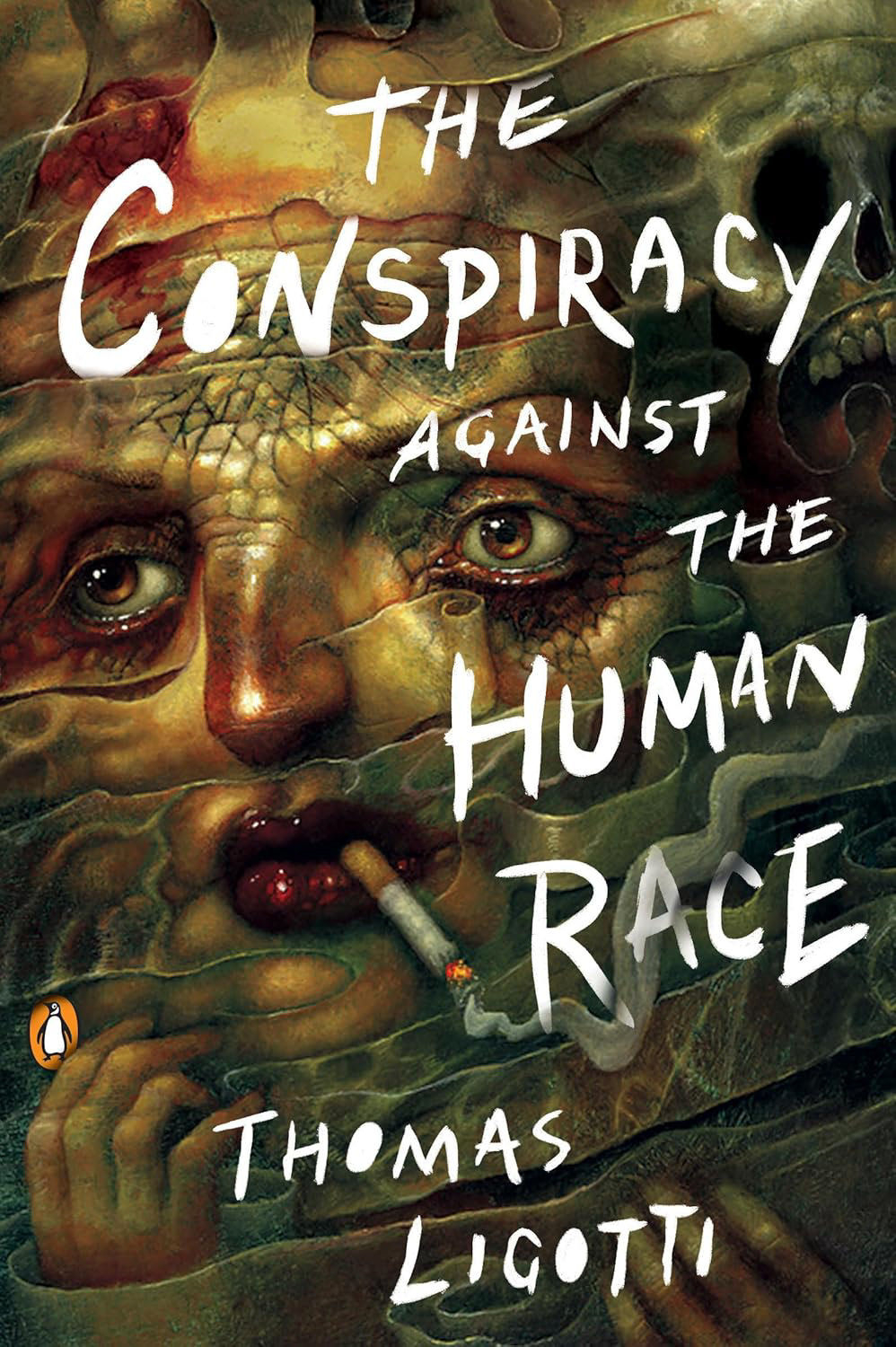
Book Review:
The Conspiracy Against the Human Race: A Contrivance of Horror
by
Thomas Ligotti
Thomas Ligotti has spent decades cultivating a reputation as one of horror fiction's most singular voices, conjuring nightmares that owe as much to philosophy as they do to the supernatural. In The Conspiracy Against the Human Race: A Contrivance of Horror, he steps away from fiction without abandoning horror. Instead, he presents a sustained philosophical meditation that argues the greatest terror is not what lurks in the dark, but consciousness itself.
Part literary criticism, part philosophical inquiry, and part personal reflection, the book explores a bleak tradition of thought stretching from Arthur Schopenhauer and Emil Cioran to H.P. Lovecraft. Ligotti assembles these influences into a provocative case for philosophical pessimism, suggesting that human self-awareness is less a gift than an evolutionary mistake. Existence, in his view, is neither purposeful nor redemptive but an elaborate illusion maintained through habit, denial, and optimism.
The book's power lies less in whether readers accept its conclusions than in the rigor with which they are presented. Ligotti writes with remarkable precision, moving comfortably between philosophy, psychology, literature, and horror cinema. His arguments unfold with the careful cadence of an essayist rather than the urgency of a polemic, allowing readers space to wrestle with ideas that are often deeply unsettling. Even moments of dark wit serve to sharpen, rather than soften, the book's uncompromising worldview.
Readers expecting practical philosophy or accessible self reflection may find the experience demanding. Ligotti assumes an audience willing to engage with difficult questions and resistant to easy reassurance. Yet beneath the intellectual density is an unmistakable literary sensibility. His prose remains elegant and atmospheric, transforming abstract concepts into vivid meditations on anxiety, mortality, and the peculiar burden of being human.
What distinguishes The Conspiracy Against the Human Race from other works of philosophical pessimism is its seamless connection to horror as an artistic tradition. Ligotti argues that horror is uniquely equipped to expose the fragile stories people construct to make existence bearable. In doing so, he elevates the genre beyond entertainment, presenting it as a mode of inquiry capable of confronting truths that more optimistic philosophies often avoid.
The book's influence has steadily expanded beyond horror literature, attracting readers interested in existential philosophy, psychology, and the darker currents of modern thought. Its uncompromising perspective has inspired admiration, criticism, and vigorous debate in equal measure. Whether one regards Ligotti's conclusions as persuasive or excessively bleak, it is difficult to dismiss the intellectual ambition behind them.
The Conspiracy Against the Human Race is not a comforting read, nor does it aspire to offer solace. It is a challenging, meticulously argued work that asks readers to examine assumptions about meaning, happiness, and consciousness that often go unquestioned. Few books are so willing to follow their ideas to their logical and unsettling end. Agree with Ligotti or not, his work stands as one of the most distinctive philosophical texts to emerge from the world of contemporary horror.
Rating: 4/5
Review
by
Michael Benesh