
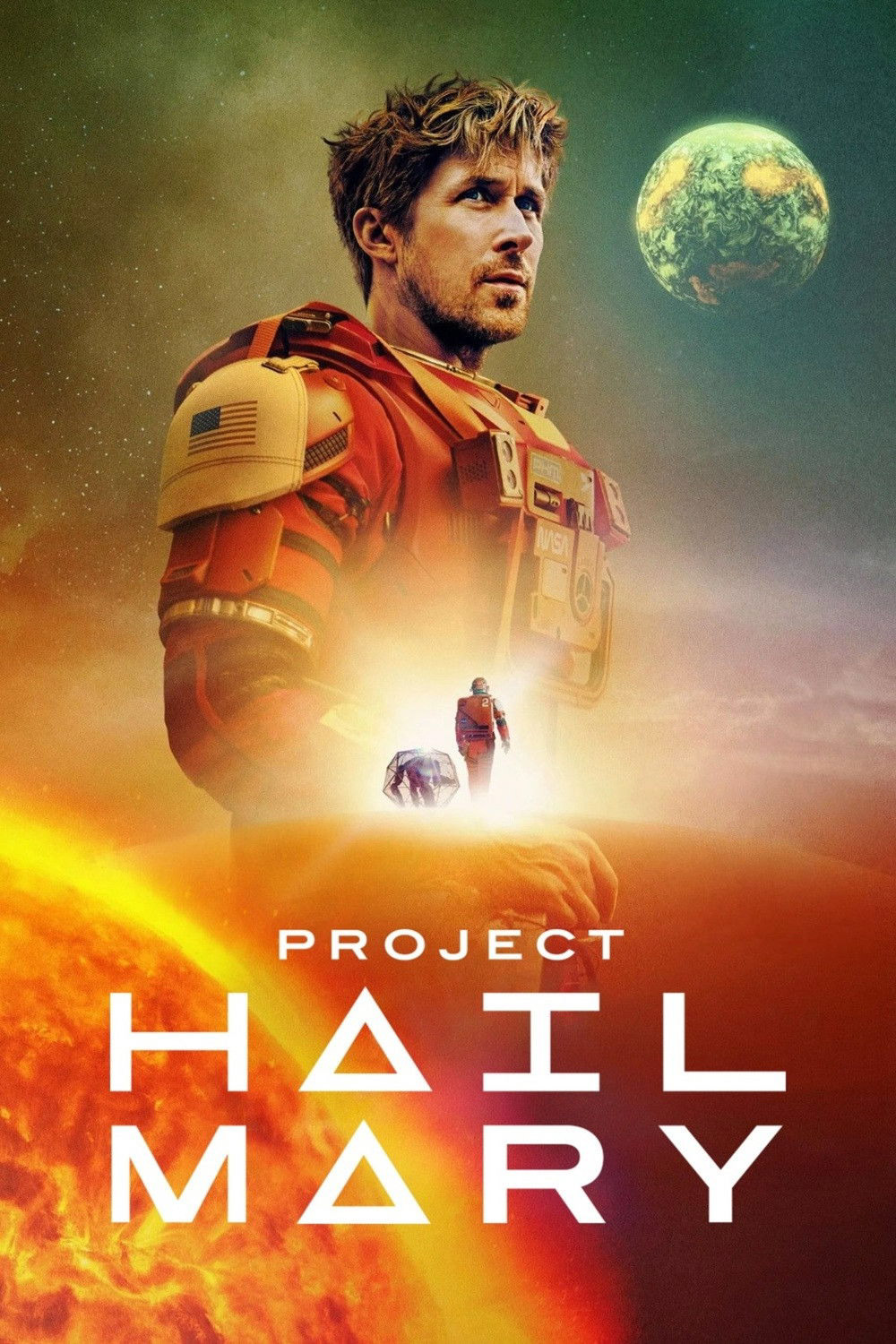
Project Hail Mary (2026)
Hope Has Never Felt This Human
There is a particular kind of science fiction that doesn't rely on massive battles or dystopian despair to leave an impact. Instead, it finds wonder in curiosity, optimism, and the resilience of ordinary people faced with impossible odds. Project Hail Mary embraces that tradition wholeheartedly, delivering a thrilling space adventure that never loses sight of the humanity at its core.
Directed by Phil Lord and Christopher Miller, and adapted from Project Hail Mary by Drew Goddard, the film follows Ryland Grace, a middle school science teacher who wakes alone aboard a spacecraft with no memory of who he is or why he's there. As fragments of his past return, he discovers that he may be humanity's last chance to stop a catastrophe that threatens life on Earth. It's a premise that could have easily become another effects-driven blockbuster, but Project Hail Mary succeeds because it understands that the most compelling discoveries are often emotional rather than scientific.
Ryan Gosling anchors the film with one of the warmest performances of his career. Grace isn't a fearless action hero or an infallible genius. He's awkward, funny, overwhelmed, and constantly questioning whether he's the right person for the mission. Gosling brings an everyman quality to the role that makes every success feel earned and every setback genuinely painful. His humor never undercuts the tension; instead, it reminds us that hope often survives through laughter.
The film's greatest strength, however, is its sense of wonder. Like the best science fiction, Project Hail Mary treats science not as incomprehensible jargon but as an act of problem solving. Every obstacle becomes a puzzle, every breakthrough a small victory. Rather than rushing from one spectacle to the next, the story invites the audience to share in the excitement of discovery, making the universe feel mysterious, beautiful, and endlessly fascinating.
Visually, the film strikes a careful balance between realism and imagination. The vast emptiness of space is breathtaking without ever feeling sterile, while the production design gives the spacecraft a lived in authenticity that grounds the more fantastical elements. The visual effects serve the story instead of overwhelming it, creating moments of awe that feel earned rather than manufactured.
Without spoiling its biggest surprises, Project Hail Mary is also an unexpectedly heartfelt film about friendship, trust, and cooperation. In an era where so much blockbuster science fiction leans into cynicism, this story dares to argue that intelligence, empathy, and collaboration are humanity's greatest strengths. It's an optimistic message, but one that never feels naïve.
What lingers after the credits isn't the scale of the mission or the complexity of the science. It's the reminder that heroism doesn't always come from extraordinary people it often comes from ordinary people who choose to do the extraordinary when no one else can.
Like the finest modern science fiction, Project Hail Mary leaves you looking up at the night sky with renewed curiosity. It's thrilling without sacrificing heart, emotionally rich without becoming sentimental, and intelligent without losing its sense of fun.
A breathtaking celebration of human ingenuity. A deeply moving story of sacrifice and connection. One of the most uplifting science fiction films in recent memory.
Rating: (4/5)
Review
by
Michael Benesh